

When a business needs to launch a new service, it no longer has to start by purchasing servers and spending weeks calculating capacity. Cloud technology gives you access to the resources you need over the internet — quickly and in exactly the amount required.
Today, the cloud has become a standard part of IT infrastructure. A user opens a work document at home, picks it back up at the office, and logs into a corporate system while traveling. For businesses, the bigger advantage is this: growth is no longer tied to how many physical servers you own.
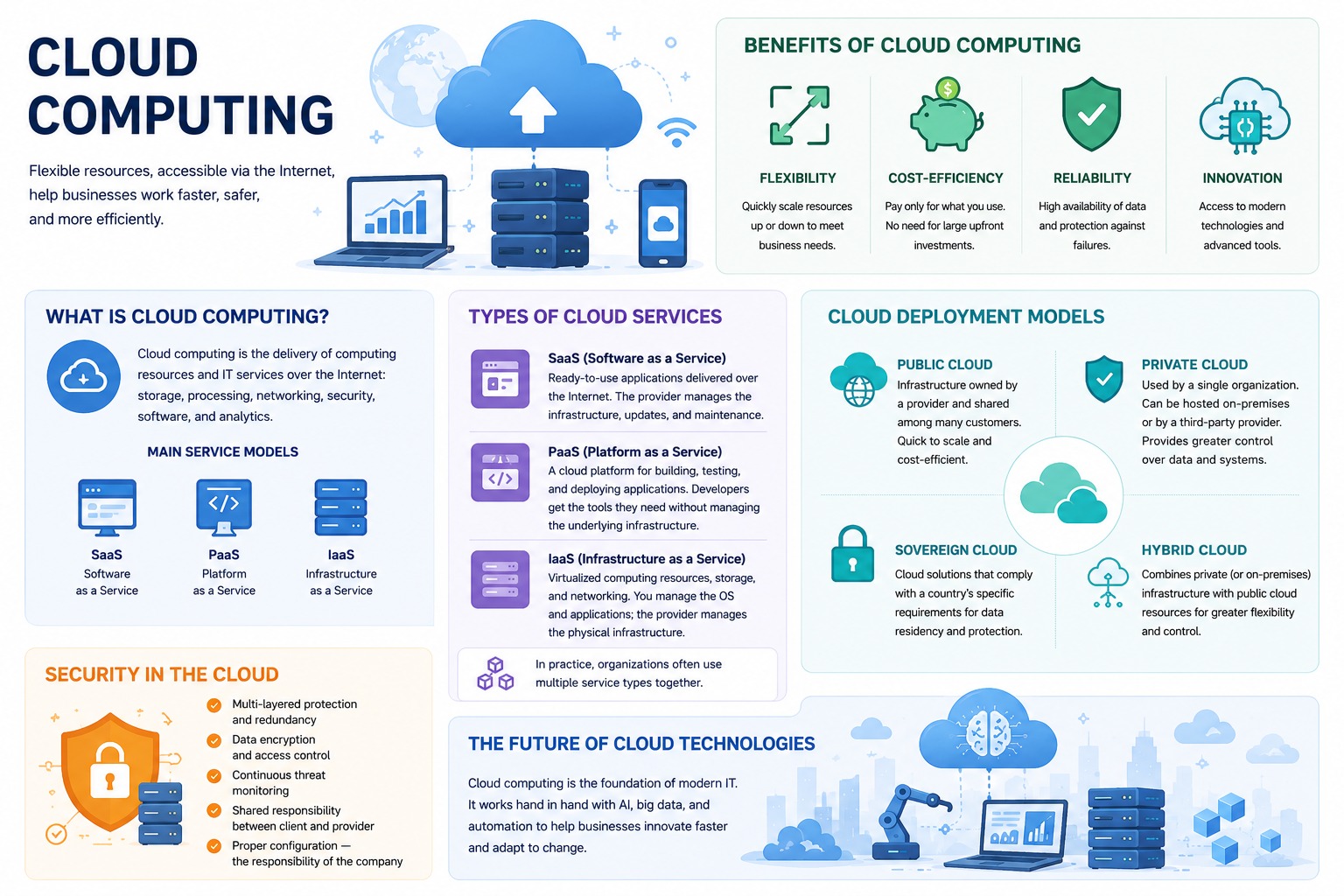
What’s actually “in the cloud”
Cloud computing refers to computing power, data storage, networking, software, security tools, and analytics delivered over the internet as a service.
Businesses get access to the resources they need without having to purchase and maintain all the physical infrastructure themselves. And those resources can scale up or down based on what the business actually needs.
Why businesses are moving to the cloud
One of the biggest reasons is flexibility. If demand spikes, you can scale up. If a project wraps up or traffic drops, you can scale back down. There’s no need to buy hardware in advance and wait for delivery.
This is especially obvious when it comes to seasonal demand. An online retailer during a major sale might need far more resources than during a typical week. Cloud infrastructure makes it easy to temporarily increase capacity and then dial it back down.
The second advantage is more predictable costs. Many cloud services operate on a pay-as-you-go model. Instead of making a large upfront investment in servers, businesses pay for what they actually use.
That said, the cloud doesn’t automatically save you money. If no one is keeping an eye on usage, unused virtual machines, storage, and services can quietly rack up unnecessary costs.
SaaS, PaaS, and IaaS: What’s the difference?
Cloud services are typically broken down into three main categories.
- SaaS delivers ready-to-use software. This includes CRM systems, productivity apps, and project management tools. Users simply work within the application, while the provider handles updates and infrastructure.
- PaaS provides a development environment. It helps teams build, test, and deploy applications without spending time managing servers.
- IaaS gives businesses more control. They rent computing power, storage, and networking, but manage the operating systems and applications themselves.
In practice, these models often coexist within the same organization: one department uses SaaS, developers work within a PaaS environment, and certain enterprise systems run on IaaS.

Public, private, or hybrid cloud
A public cloud works well when speed and scalability are the priority. The provider manages the infrastructure, and its resources are shared across many customers.
A private cloud is dedicated to a single organization. It’s typically chosen when a higher level of control over infrastructure and data is required.
A hybrid model combines on-premises or private resources with public cloud infrastructure. For example, sensitive data can stay in a controlled environment while workloads with unpredictable demand are shifted to the public cloud.
A separate category worth noting is sovereign clouds, which are built to comply with a specific country’s requirements around data residency, processing, and protection.
Who’s responsible for security?
Moving to the cloud doesn’t automatically make a system secure.
The provider protects its own infrastructure using redundancy, encryption, monitoring, and other security measures. But the business remains responsible for access configurations, employee accounts, user permissions, and how sensitive information is handled.
A simple example: even a well-secured cloud platform won’t protect your data if an employee is given excessive permissions or their password ends up in the wrong hands.
Cloud security is always a shared responsibility between the provider and the customer.
Why the future of IT is increasingly cloud-driven?
The cloud has evolved well beyond just a place to store data and spin up virtual servers.
Cloud platforms are now how businesses get fast access to tools for big data analytics, machine learning, generative AI, and automation.
Companies don’t have to build every capability from scratch. Many of these tools are available as ready-made services that can be tested on a real use case and scaled up if they prove valuable.
That’s why, in the years ahead, the cloud will increasingly be seen less as a standalone technology and more as the foundational environment for digital business.
The real value isn’t in the servers themselves — it’s in speed: the ability to test an idea faster, launch a product sooner, scale up capacity when demand grows, and restructure infrastructure when business needs change.