
The digital industry now grows through a mix of connected fields. Machine learning, robotics, cloud services, sensors, telecom systems, and biomedicine often overlap. What’s new in information technology is therefore not only a new tool or device. It is also how several technologies work together. Useful progress depends on fast adoption, reliable systems, and good data.
New technologies in IT
Modern IT is moving into more parts of daily life and business. Some changes are visible; others happen inside networks and software.
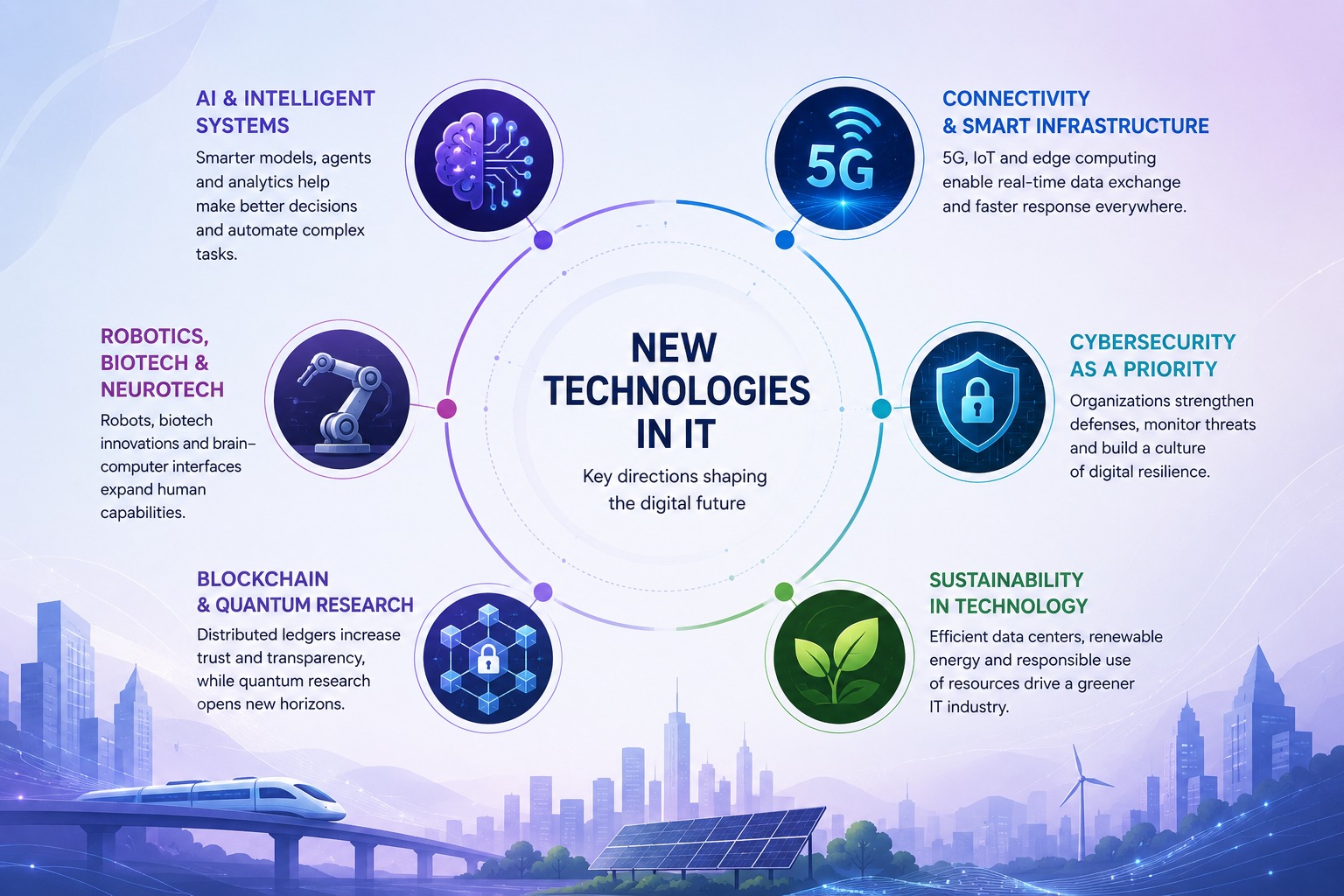
Artificial intelligence is becoming more autonomous
Generative AI can create text, images, and code. AI agents can go further. They may break a task into steps, use available tools, and check results. These agents are one example of new technologies in IT, alongside prediction, automated analysis, and decision support.
People still set the goals and limits. Human review matters when a result may affect customers, staff, or business decisions.
Companies use algorithms to forecast demand, find unusual activity, assess risk, and improve operations. Their value depends on accurate data, clear rules, privacy controls, and ways to catch errors.
Connectivity supports smarter infrastructure
5G networks can provide high speed and low delay. That can help cars, sensors, drones, and medical devices exchange information quickly. It gives the Internet of Things more room to grow.
Edge computing handles data closer to its source. Instead of sending everything to a distant center, some information can be processed at a factory, store, transport hub, or hospital. This can reduce delays and ease pressure on remote servers.
Cybersecurity becomes a business issue
Cloud services and connected devices mean more possible entry points for attackers. Threats can include automated phishing, fake voices, deepfake videos, tailored messages, and social engineering.
Organizations may respond with monitoring, multifactor authentication, network segmentation, backups, and staff training. These steps cannot remove every risk, but they can make attacks harder and improve recovery.
Sustainability matters more
Data centers need large amounts of energy. As computing demand grows, efficiency becomes more important. Operators can use efficient processors, better cooling, and renewable power where available.
Repair, reuse, and recycling can reduce electronic waste. Software can help companies track energy use, manage resources, and plan better logistics.
Blockchain and quantum research
Blockchain is not limited to cryptocurrency. Distributed ledgers can support product tracking, transaction records, smart contracts, and services that need a shared history.
Quantum computing is still an emerging field. Researchers are studying possible uses in chemistry, materials, optimization, and cryptography. Post-quantum encryption is also being developed for future security risks.
Robotics, bioengineering, and neural interfaces
Robots are becoming more flexible through computer vision, machine learning, and better controls. They already appear in factories, warehouses, clinics, and logistics.
Computing and biology are moving closer together. Examples include genomic analysis, personalized medicine, gene editing, and brain-computer interfaces. These areas need strong computing systems and careful protection of sensitive information.
Immersive tools become more practical
Virtual and augmented reality can support training, design, maintenance, and planning. Digital twins add another option. A virtual model of a real system can help teams test scenarios, watch performance, and spot problems early.
The broader direction is integration. AI, robotics, networks, sensors, and biotechnology can support each other when they work together. The main challenge is not simply adding more technology. It is building systems that are useful, secure, efficient, and easy to understand.