

Modern companies generate large volumes of data every day, but raw data rarely tells the full story on its own. It first needs to be collected, verified, organized, cross-referenced, and transformed into a usable format. At various stages of this process, businesses may rely on databases, analytics platforms, cloud services, and other information technologies for data processing — the specific tools used will depend on the nature of the tasks and the existing infrastructure.
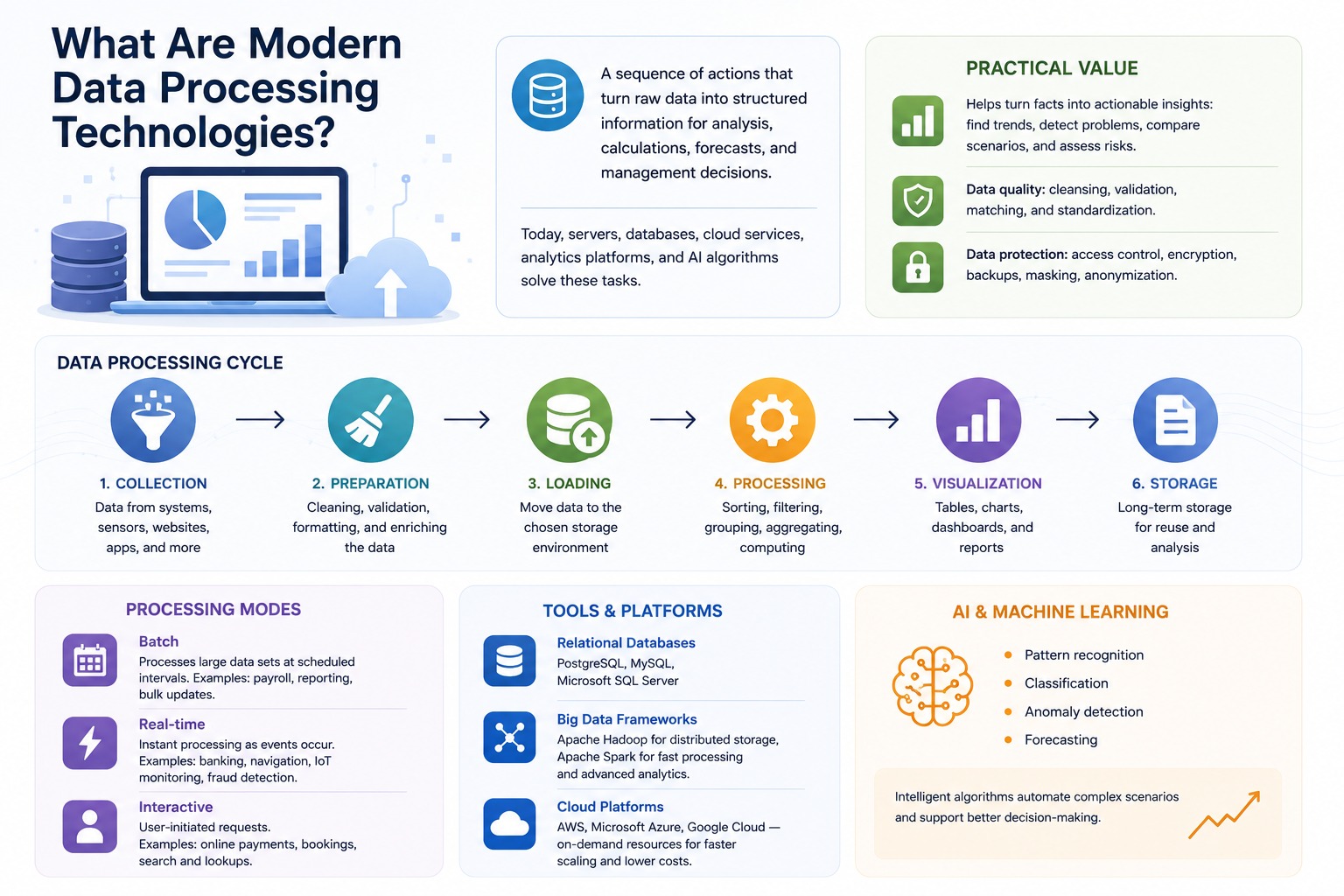
What modern information technologies for data processing actually are?
This term refers to a sequence of operations that transform raw data into structured material suitable for analysis, calculation, forecasting, and informed decision-making.
Many of these operations were once performed manually. A major milestone in automation came with Herman Hollerith’s tabulating machine, developed in the late 19th century to process the results of the US census. Mechanical devices were later replaced by electronic systems. Today, the work is handled by servers, databases, cloud services, analytics platforms, and artificial intelligence algorithms.
Practical value
Well-organized data work enables businesses to move from isolated facts to actionable insights. Sales figures can reveal demand trends, production metrics can surface problem areas, logistics reports can identify delays, and historical data can be used to compare scenarios and assess potential risks. These examples illustrate what information technologies for data processing are really designed for: not simply storing numbers, but working through them systematically — from validation and cross-referencing to delivering results in a clear, usable format.
Before reaching that stage, raw datasets often require significant preparation. They may contain gaps, duplicates, incorrect values, or inconsistent formatting for the same data points. As a result, the data must be cleaned, standardized, reconciled across sources, and only then passed on for further analysis.
Data security is another important piece of this work. Depending on the nature of the system, this can involve access controls, encryption, backup procedures, data masking, or anonymization. These measures serve different purposes: restricting access to sensitive information, enabling recovery of lost data, or reducing the risk of exposing personal information.
Stages of the processing cycle
The process begins with collection. Data sources include enterprise applications, transaction logs, sensors, websites, surveys, terminals, and third-party services. The data then goes through preparation: incorrect values are corrected, duplicates are removed, formats are standardized, and missing attributes are filled in.
The next stage is loading the data into the chosen environment. Once transferred, processing begins: sorting, filtering, grouping, and aggregating. The resulting outputs are visualized through tables, charts, graphs, and dashboards. The cycle concludes with long-term storage, which allows the data to be accessed and reused in the future.
Core processing modes
Batch processing is well-suited for accumulated datasets that are handled at scheduled intervals. Common examples include payroll processing, report generation, and bulk updates to registries.

Real-time processing enables near-instant responses as events occur. This approach is essential for banking services, navigation systems, industrial monitoring, and fraud detection tools.
Interactive processing requires direct user input. This is the model behind completing a purchase, placing an order, booking a ticket, or searching for a record within a catalog.
Tools and platforms
For structured storage, relational database management systems are widely used — including PostgreSQL, MySQL, and Microsoft SQL Server. These support tables, relationships, indexes, queries, and transactions. For high-volume workloads, distributed solutions are often preferred. Apache Hadoop distributes datasets across multiple nodes, while Apache Spark is designed for fast computation and complex analytics.
Cloud infrastructure from AWS, Microsoft Azure, and Google Cloud provides on-demand computing power. Organizations can scale resources up or down without purchasing hardware, which speeds up project deployment.
Machine learning and intelligent algorithms occupy a distinct role in this space. These methods identify patterns, classify objects, detect anomalies, and generate predictions. By automating complex logic, they enable more sophisticated data-driven decision-making.