

Picture a typical release: developers finish a feature, hand it off to QA, then pass it to operations. At every stage, there are manual steps and delays. DevOps changes that dynamic — teams work together, and automation handles most repetitive tasks.
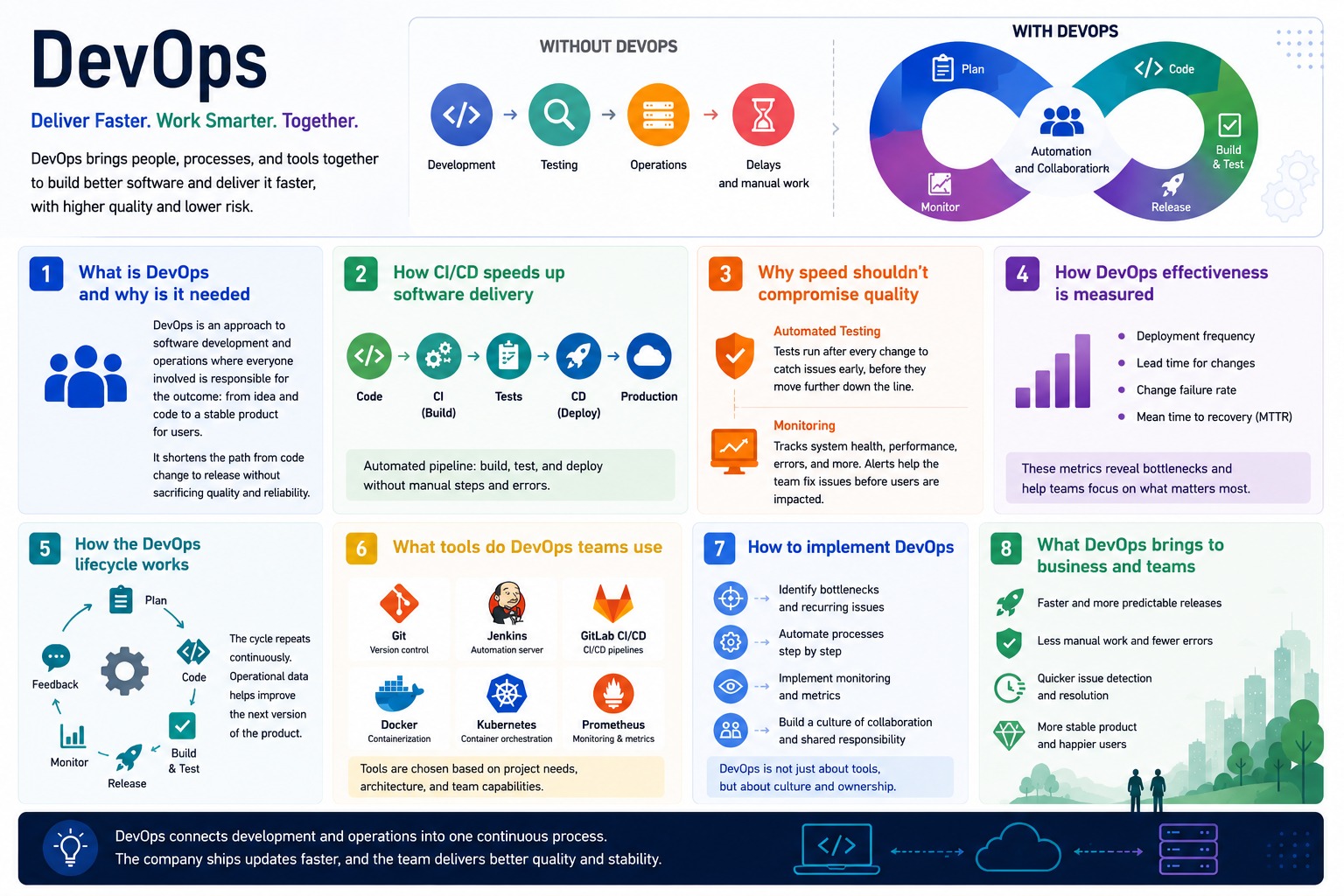
What Is DevOps and why does it matter
DevOps is an approach where everyone shares responsibility for the outcome — from the initial idea and writing code to keeping the product running smoothly for end users.
The goal is to shorten the path from a code change to a new release without sacrificing quality or reliability. To do that, developers, testers, and operations engineers build a shared workflow and minimize their dependence on manual processes.
How CI/CD speeds up software delivery
One of the core pillars of DevOps is CI/CD. Continuous Integration (CI) means developers regularly contribute changes to a shared codebase, and the system automatically builds the project and runs checks. If a change breaks something, the team finds out right away — before the issue travels further down the pipeline.
CD handles preparing and deploying a version to production. Building, testing, and deployment all follow a pre-configured workflow, reducing manual steps and the risk of accidental mistakes.
Why speed shouldn’t come at the cost of quality
Fast releases don’t mean much if every update is followed by an emergency fix. That’s why DevOps goes hand in hand with automated testing. After code changes are made, the system checks that existing functionality still works. The earlier a bug is caught, the easier and cheaper it is to fix.
Once a release is out, monitoring tracks application health — response times, load, errors, and other key metrics. If something falls outside acceptable limits, the team gets an alert before it affects a large number of users.
How DevOps performance is measured
The impact of DevOps can be measured with concrete metrics: how frequently new versions ship, how long it takes from a code change to a release, what percentage of updates cause incidents, and how quickly the system recovers after a problem.
These metrics help surface real bottlenecks. A team might be shipping frequently but recovering too slowly from bad releases — in that case, the focus should shift toward improving testing, monitoring, or the recovery process.
How the DevOps lifecycle works
The work doesn’t stop once an application is deployed. The team plans changes, writes code, builds and tests the product, ships a new version, monitors its health, and analyzes operational data — which then feeds back into planning.
That’s why DevOps is a continuous cycle: every release generates data that helps improve the next one.

Tools DevOps teams use
Common tools include Git for version control, Jenkins and GitLab CI/CD for pipelines, Docker for containerization, Kubernetes for managing containerized services, and Prometheus for metrics and monitoring.
That said, installing popular tools doesn’t automatically make a process DevOps. Tools are chosen based on a team’s specific architecture, project requirements, and capabilities.
How to implement DevOps
Start with the processes that consume the most time or cause the most errors — manual builds, slow testing cycles, or a complicated deployment process. From there, gradually automate operations, set up monitoring, and define metrics to track progress.
The technical side alone isn’t enough, though. If developers think their job ends at handoff and operations only gets involved during outages, DevOps will amount to nothing more than a collection of scripts. The approach works when teams communicate openly, review incidents together, and take shared ownership of product quality.
What DevOps delivers for the business and the team
A well-implemented DevOps practice shortens the time between an idea and its release, reduces manual work, and makes releases more predictable. Bugs are caught earlier, and incidents are contained more quickly.
Ultimately, DevOps connects development and operations into a single, unified process — giving organizations the ability to ship updates more frequently while giving teams better visibility and control over software quality and stability.